
The Highlights and Challenges of Lab Management Operations
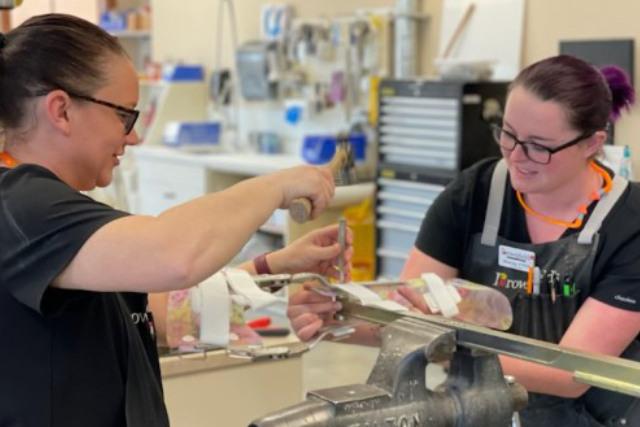
In addition to being the lab manager for the past six years, l am also the maintenance and safety manager for Brownfield's Prosthetic & Orthotics practice in Meridian and Nampa, Idaho. I have learned a fair amount on the job through trial and errors which have pushed me to grow. I manage the lab with two technicians who work under my guidance.
Presently, we are an all-female technical team which has changed the dynamic in the lab from what it has been in the past. I was the first female technician to join the Brownfield's O&P practice and have paved the way to shed light on what a female technician can really do. Our facility has five COs which keep the lab remarkably busy. To manage the lab efficiently, a variety of organization and multitasking skills are needed and required.
Practicing LEAN processes is what we utilize to stay efficient in every aspect at our facility. The management staff meet weekly to discuss what is or is not working in each of our departments. This exchange of ideas and suggestions has allowed me to grow as a manager, focusing on what/how the future of the technical department will look like and how to implement recommended changes.
Brownfield's was founded in 1949 and over the years has made a significant impact on our community. I am proud to continue the legacy that Brownfield's has built within our community and service area. The O&P field in the Treasure Valley is competitive; and nothing makes me happier than receiving a review from a patient stating that "they prefer Brownfield's staff and fabrication work."
My technical staff is held to a high standard and pushed to pay attention to the intricate details on the devices we make. The quality checks I implemented hold my staff and the practitioners accountable to verify that each newly created device is correct in all facets. Two separate quality check sheets, one for orthotics and one for prosthetics, are in use. These check sheets make the technician evaluate and examine every part of the device from smooth edges, covered rivets, padding
thickness, and if Loctite and torques were applied. This process helps to set Brownfield's apart from competitors, allowing us to refine our fabrication and processes to achieve the best possible outcomes for our patients. Our devices do not just pass the check of being "good enough;" every project/device needs to be created with pride to look the absolute best for our patients.
I know that there is always room for improvement, so I am constantly seeking ways to improve our fabrication techniques. One such way is to create lighter yet stronger laminations with materials that will not cause harm while keeping the sockets strong and durable. Materials such as NSP braid over carbon and Super Bond glue that is a little healthier than Barge are two of the changes we have made. Our technical team are constantly challenging each other with questions on why we
fabricate a certain way causing us to learn new techniques or think outside of the box for improvement.
One issue I have been able to work closely on with practitioners is designing our own adjustable sockets using the click medical Revo Dials. Some of these projects have been time-consuming to figure out but have given positive results for the patients. I am enthusiastic about the importance of continuing to learn by trial and error. I believe that keeping an open mindset and being able to learn from your mistakes will make you the best technician you can be.
As a manager, I want my technicians to be passionate about their work and fabrication skills, recognizing that this is a career and not just a job. Involving the technicians in the more difficult projects and having them see patients walk with their new device in our hallway reinforces the connection that we are not just working with plaster and plastic. As all of you know, technicians make a difference in the lives of our patients. Without us, the patient might not be able to walk. I have made an impact on many patients' lives who know me by name and are happy to hear that I continue to work at Brownfield's. Restoring independence and renewing the lives of our patients is why I choose to come to work every day at Brownfield's. From a management perspective, I continually revisit processes that we have implemented and ask the question "how can we make this function more efficiently?" Sometimes I produce ideas and other times I turn to my team for their insights into what
is or is not working. I ask the technicians what a pain point is and how can we improve this process?
By staying organized with procedures that I question, I can run an efficient lab, even when I am out of the office. We practice doing team huddles to set project goals for the day or week which helps us stay focused on getting projects out in a timely manner. Projects in our facility are organized by the first in first out method unless there is a high priority or hospital call project that comes in.
I have received feedback from my technical staff that they appreciate how empathetic and caring I am about their individual situations. As the manager, I have earned their respect, so they trust me with outcomes/choices for whatever is needed. This behavior applies with other staff members in our clinic that need to talk to a manager who listens and cares about what is happening within the company.
Conversely, you must look at your lab and your staff with a critical lens. If you do not, processes may become erratic and lazy allowing checks and balances to slip through the cracks. As the manager, you must remain subjective about every action or issue that occurs in the lab to make choices that can be critical in the success of the business. I always appreciate learning how other managers have solved staff member issues in the past employing techniques to resolve future problems that might arise.
When you must talk with a staff member about an issue or problem, it is best to remain unemotional and levelheaded. This is a key aspect of lab management that I have been working on the most to improve. I have reflected on the changes we have implemented in the past year and my outlook for the lab in the years to come. This action and behavior show that perceive my lab management role seriously and is appreciated by upper management at Brownfield's. My goal is to continue to grow to become a better and stronger manager over time.
I hope that you, as a technician or a lab manager, find your passion and purpose in the work that you do in the orthotic and prosthetic field and challenge yourself to keep learning and growing every day.
About the Author
Shawna Ross, CTPO is the lab manager at Brownfield's Prosthetics & Orthotics practice in Meridian, Idaho. She graduated from the Spokane Falls Community College O&P Technology Program in 2017 and became fully certified in both orthotics and prosthetics within 6 months of being hired at Brownfield's P&O.
Shawna was hired to be the second in command to help run the lab and has been with the practice for 8 years. In 2019, Shawna was promoted to lab manager and quickly accepted her new position and took it with stride. She works with an outstanding team of managers at Brownfields who are always supportive and ready to help when needed.
Outside of work, Shawna is a bit of a nerd, playing a lot of tabletop games and enjoying painting mini figures that are integrated into the games. Her absolute favorite activity outside of work is riding her Indian Scout Bobber motorcycle. She muses that it may seem strange to create prosthetic devices for those who have lost a limb in motorcycle accidents, but states that the motorcycle ride brings a very free feeling that she loves. "Life is all about perspective and it is too short to not enjoy the things
you love because of the "what ifs" in this world."
Shawna is the proud mother of a 6-year-old and has now been a gestational surrogate twice for the same family. She notes that being pregnant in the lab setting really opened her eyes to question the chemicals and materials that are used. This began a quest to determine how to make the lab safer for herself and the other staff members ensuring that everyone in the lab is working in the healthiest environment possible.
